
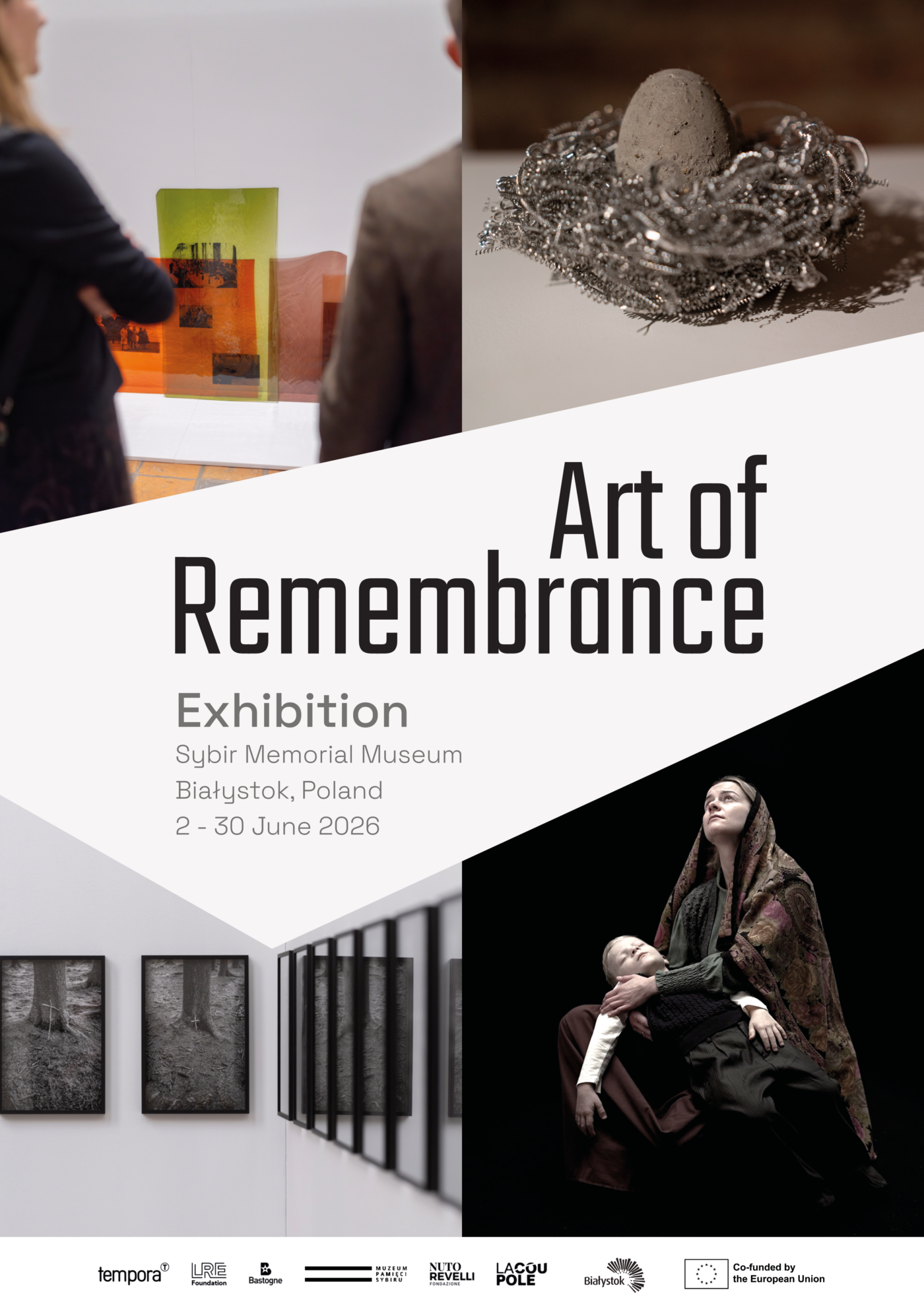
The Art of Remembrance exhibition is travelling to Poland and will be officially launched at the Sybir Memorial Museum in Białystok on Tuesday, 2 June 2026.
The four international artists Juhana Moisander, Gail Ritchie, Raphaël Dallaporta and Rebekka Bauer created a wide range of artworks for the exhibition, including glass installations, sculptural and organic materials, drawings, photography, film, and immersive sound. Each work is rooted in vigorous research connecting European WWII heritage with contemporary art, inspiration was found in the four host sites Paraloup, Italy; the Bastogne War Museum, Belgium; the Sybir Memorial Museum, Poland; and La Coupole WWII Museum, France.
The works highlight perspectives that often remain at the margins, from women’s roles in resistance and survival and intergenerational remembrance, as well as the presence of non-human witnesses such as animals and landscapes. Attention is also given to how trauma is gradually absorbed by the organic environment.
A press conference will be held on Thursday, 28 May 2026, to present the exhibition and the Art of Remembrance project to local and national news outlets. The four artists as well as Tempora curator Isabelle Benoit will join online to give more insights into the artistic process and creation of the artworks. Speeches will be held by the Mayor of Białystok Tadeusz Truskolaski, and the Director of the Sybir Memorial Museum, Wojciech Śleszyński, as well as the Head of the Department of Educational and Cultural Projects Piotr Popławski.
Finnish artist Juhana Moisander will be in attendance during the launch event on 2 June to present his video installation MATKA that he created during his residency at the museum last year.
The exhibition is free to visit and will be open until Tuesday, 30 June 2026.
Alongside the exhibition, a public programme of workshops, guided tours and educational activities will be offered during its opening period, giving visitors the opportunity to dive more deeply into the artistic processes and the broader questions around how memory is shaped and transmitted today.